
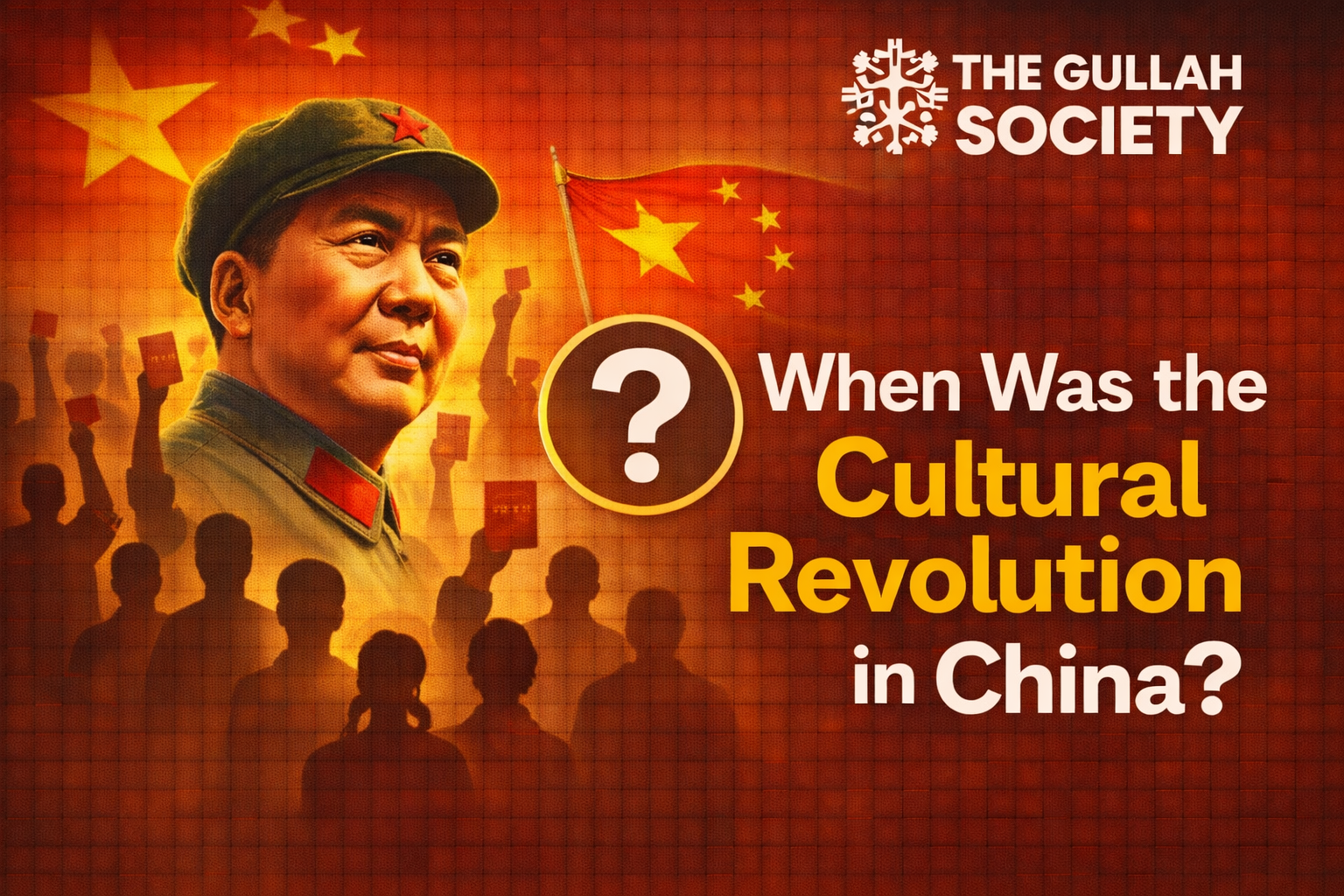
You usually see the Cultural Revolution dated from 1966 to 1976, and those are the years you should use in most writing. You also need to know that 1966 marks the political launch and mass mobilization, while 1976 marks the leadership transition and arrests that closed the era.
In this guide, you will learn the exact dates, the major phases, and the key events that explain why the timeline is widely accepted yet still discussed, so you can cite it correctly in essays, captions, and study notes.
The short answer you can cite with confidence
The Cultural Revolution in China is generally dated from 1966 to 1976, and many references add precision by pointing to May 1966 as the start of the public campaign. You can use 1966 as the beginning because that is when Mao Zedong called for renewed revolutionary struggle, and the movement surged into schools, streets, and workplaces.
You can use 1976 as the ending because Mao died in September 1976 and the Gang of Four were arrested in October 1976, which signaled that the movement’s political engine had stopped.
If you need a one-line answer for a caption or quiz, say it lasted from 1966 to 1976. When you want a simple way to think about how people hold onto identity when public life becomes ideological, notice how a Gullah community keeps heritage visible through everyday practice rather than official slogans. If you need a slightly more precise answer, say it began in May 1966 and effectively ended in October 1976.
A quick way to remember the span is to link the start to mobilization and the end to leadership change. That method keeps you from drifting into vague language like “the late 1960s” when readers are asking for a date, and it also reminds you that culture is lived, not just declared, as seen in Gullah culture. It also helps you explain why the decade matters, since each endpoint corresponds to a visible political shift.
Why 1966 is treated as the beginning
The Cultural Revolution did not appear overnight; political tension and ideological debate were already building within the Chinese Communist Party before 1966. In 1966, Mao framed the moment as a fight against people he believed were leading China toward a capitalist path, and he pushed the struggle into public life rather than keeping it confined to elite meetings.
Once students and young activists organized as Red Guards and received political encouragement, the campaign became a nationwide upheaval rather than a limited internal dispute.
Start dates matter because you need to separate background causes from the moment a campaign changes everyday life. When identity and tradition become political targets, communities often defend meaning through shared practices, and you can see the logic of cultural resilience in their efforts to protect shared meaning. With that distinction in mind, 1966 is the clearest start year because it marks the shift from internal argument to mass movement.
You should be careful not to confuse planning with ignorance in Gullah. Some debates and cultural criticism had already built up, but the public wave that reshaped schools, neighborhoods, and institutions is what most people mean when they ask “when was it.” Using 1966 as the start respects everyday reality while still leaving room to mention the earlier background in a longer research project.
The early phase from 1966 to 1968
From 1966 to 1968, political life became intensely polarized as accusations of disloyalty spread and ordinary relationships were weaponized. This phase is described through rallies, denunciation,s and violence, including attacks on teachers, officials, writers, and other people labeled enemies of the revolution. Many cultural and religious sites were damaged, and daily security collapsed as competing factions fought to prove they were the most revolutionary.
Education was disrupted, and local governance fractured because public campaigns replaced routine administration, and expertise was treated as suspicious. Families were pushed to denounce relatives, and people were forced into re-education through labor, struggle sessions, or relocation. If you are trying to date the most chaotic and visually recognizable part of the Cultural Revolution, it is often concentrated in these early years.
The early phase also created a dangerous feedback loop, because public accusations encouraged more accusations and made moderation look risky. Another way to remember continuity is to notice how everyday speech can preserve identity across time, similar to how Gullah language carries heritage through ordinary conversation. When you write about the timeline, describe 1966 to 1968 as the period when ideology became a constant public test.
The shift toward tighter control from 1968 to 1971
As factional conflict spiraled, the state increasingly relied on the military and more formal structures to restore order and reestablish basic governance. This shift did not end the Cultural Revolution, but it changed how power worked by moving from youth led mobilization toward tighter institutional control. You can think of 1968 to 1971 as a period when the movement’s energy was redirected into consolidation, discipline, and political sorting rather than constant street upheaval.
Even with greater control, political suspicion remained the norm, and careers could rise or fall with shifting ideological winds. These years matter because they show why the Cultural Revolution is not just a burst of Red Guard activity, but a long political process with multiple gears. When you explain the timeline, emphasize that the late 1960s were about mass mobilization, while the transition into the early 1970s was about managing the wreckage mobilization left behind.
If you want one sentence that captures the change, say the campaign moved from chaotic factional conflict to managed campaigns that still punished people but with more administrative structure. That keeps your writing accurate without getting lost in names and sub-factions. It also helps readers accept why a decade-long date range can be correct even when the intensity shifts.
Key dates and a simple timeline you can memorize
If you want to keep the timeline straight, focus on a small set of anchors rather than memorizing every incident. Start with 1966 for the official launch, track the 1966 to 1968 surge, and remember 1976 as the closure with Mao’s death and the Gang of Four arrests. Between those bookends, a few milestones help you show turning points and shifts in control.
Here are practical anchors you can use in notes and writing:
- 1966: launch of the Cultural Revolution and the rise of the Red Guards
- 1967 to 1968: peak factional conflict and widespread persecution
- 1968 to 1971: military and state consolidation, ongoing political campaigns
- Early 1970s: continued ideological pressure with less visible chaos
- 1976: end of the era after Mao’s death and the arrest of the Gang of Four
Use this list as a map rather than a full history, then add detail only where your audience needs it. If your goal is clarity, fewer dates with better explanations will outperform a long list of years. The key is to show how each date connects to a visible change in power, violence, education, or governance.
What happened in the early 1970s and why it still counts
Many readers assume the Cultural Revolution ended when street violence slowed, but the movement continued as a political reality into the early 1970s. Campaign language, loyalty tests, and ideological policing remained embedded in institutions, even as daily life looked more stable than in 1967. That is why historians still place the period inside the 1966 to 1976 frame, rather than ending it early.
Experiences differed by region and workplace, so some people felt the worst in 1967 while others felt pressure for years afterward. The most important point for your timeline is that institutional consequences continued, including distorted education, damaged trust, and ongoing political sorting. If you explain that continuity, readers understand why the decade range remains the standard answer.
You can summarize the early 1970s as an aftershock period, in which the same political logic persisted even as outward chaos diminished. That framing keeps you accurate while helping readers understand why 1976 is still needed as an endpoint. It also explains why personal memoirs can emphasize different years while historians still agree on the decade span.
When and how the Cultural Revolution ended in 1976
The most widely accepted endpoint is 1976, because the leadership that drove the campaign lost its central figure and then its inner circle. Mao’s death in September 1976 created a power vacuum, and the arrest of the Gang of Four in October 1976 is often treated as the decisive political break. When you need one date to mark the end, October 1976 is an easy, defensible choice because it ties the endpoint to a concrete action rather than a gradual mood shift.
After 1976, China moved toward policy reversal and institutional rebuilding, even though the social damage could not be undone quickly. The Party later described the Cultural Revolution as a serious mistake, which helped create an official boundary around the decade. If you are explaining the timeline to someone new, emphasize that 1976 ends the movement’s leadership structure, and the years after are about reckoning and reconstruction.
Be careful with your wording, because “ended” does not mean the pain ended on a single day. Many families carried stigma, missing education, and mistrust into later decades, and some policy changes unfolded gradually. Still, for answering when it happened, 1966 to 1976 remains the clearest and most responsible timeframe.
Why the topic is sensitive and why timelines get simplified
The Cultural Revolution remains sensitive because it raises hard questions about leadership, mass campaigns, and political violence carried out in the name of virtue. Official condemnation exists, but public discussion can be limited, and that shapes what many people learn in school and see in media. When memory is managed, timelines can become simplified, which is why you should return to the core dates and explain them with care.
You can discuss sensitivity without sensationalism by focusing on what the decade did to trust, community life, and everyday safety. People were pressured to perform loyalty, labels could follow families for years, and those experiences can make open conversation difficult even long after the events end. A careful timeline gives readers a stable frame while you acknowledge that memories are personal and often painful.
This is also why you sometimes see vague phrases like “the turmoil of the era” instead of exact endpoints. Your reader does not need dramatic language, because the facts are already serious. Your job is to keep the dates clean, connect them to recognizable phases, and avoid turning complexity into confusion.
How to answer the question in essays and avoid common confusions
When you answer “when was the cultural revolution in china,” start with the decade frame and then decide whether you need month level detail. For most SEO content and student work, 1966 to 1976 is correct, memorable, and aligned with common references. If you need precision, add May 1966 for the public launch and October 1976 for the decisive political break.
A common mistake is to treat the Red Guard years as the entire Cultural Revolution, which erases the longer institutional phase and the 1976 closure. Another mistake is to treat earlier debates as the start, which blurs background causes with the moment the campaign became a mass movement. You avoid both mistakes by stating the official span first, then summarizing phases in one paragraph, and then naming one or two anchor events.
A simple writing method is to pair each phase with one institutional effect, such as education disruption, administrative purges, or military stabilization. You can also pair each endpoint with one reason, such as 1966 mobilization and 1976 leadership change, so the dates do not feel arbitrary. If you follow that structure, you will sound clear, accurate, and genuinely helpful rather than repetitive.
Conclusion
When was the cultural revolution in china is best answered as 1966 to 1976, with May 1966 and October 1976 as useful precision markers when you need them. You stay accurate when you describe the early Red Guard surge, the later consolidation, and the 1976 endpoint tied to Mao’s death and the Gang of Four arrests, because that structure matches how the movement unfolded across time and shows your reader what changed in society from phase to phase.
If you keep the official span clear, choose a few anchor dates, and connect each date to a real change in society, your timeline stays accurate and easy to trust for essays, exams, and quick fact checks without confusing your reader.